The Plan to Make Public Street a Public Good
By Joshua Geaughan and Alana Lemene
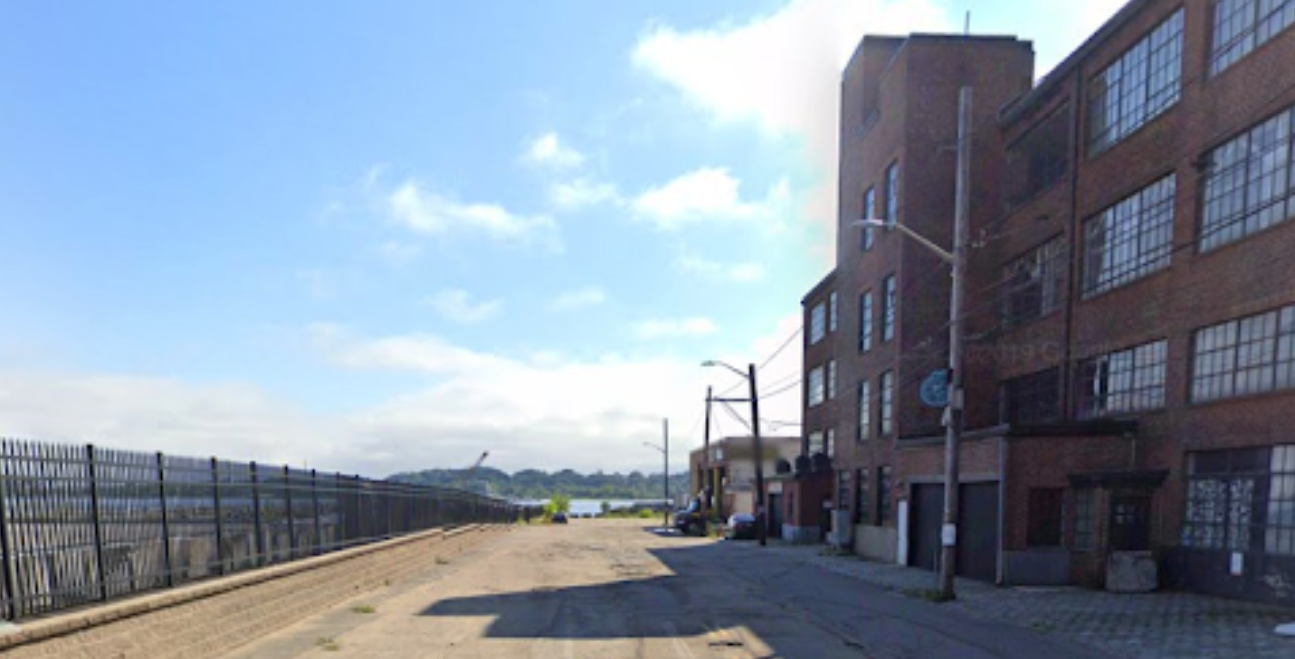
Photo via google street view
Sandwiched between scrap metal recycling and mounds of salt, Providence’s Public Street is getting a makeover. As a result of the Washington Park community’s efforts to find a way to cohabitate with the Port of Providence, Public Street — one of the 234 public right-of-way points in Rhode Island — could be a prime example of the impact of community activism. As a collaboration among the city’s Department of Sustainability, the local nonprofit Save the Bay, and local grassroots organizations People’s Port Authority and the Washington Park Neighborhood Association, the Public Street project aims to change the landscape of the port into an area of public access and enjoyment.
Rhode Island shoreline access
In 2023, the Rhode Island General Assembly passed the Rhode Island Shoreline Access Bill, clarifying a previous ruling legally defining the “shoreline” and the public’s access to it. This bill built upon the previously established “shoreline privileges” in the Rhode Island constitution, solidifying Rhode Island residents’ rights to swim, fish, and access any shore in the state.
The 2023 bill specified the preexisting bill, stating, “The public’s rights and privileges of the shore may be exercised, where shore exists, on wet sand or dry sand or rocky beach, up to ten feet (10′) landward of the recognizable high tide line.”
This effectively enshrines that Rhode Island’s coast is publicly owned within 10 feet from the high tide line; however, the logistics of such a freedom have frequently prevented the law’s simple goal. To get down to those public shorelines, Rhode Islanders have to use established “rights of way,” or public access points. Public Street is one of these points, and its underutilized space highlights a lack of equity in enforcing public access to the shoreline.
“There are 234 rights of way to the shore that are designated by the CRMC [Coastal Resources Management Council]. So in theory, there are 234 places where anybody can go and walk down a little path and get to the shore and fish, sit on the bay, and collect seaweed. But of those 234 rights of way, many of them have overgrown vegetation, many of them are in residential neighborhoods where there isn’t any signage,” explains Jed Thorp, Save the Bay’s advocacy coordinator.
The general lack of education regarding the public’s rights to the shoreline and the right-of-way access points is what makes a simple law extremely complicated. Denizens often don’t feel comfortable walking or parking in residential neighborhoods to use these spots, out of fear of trespassing. A lack of information about public access policies makes the situation even more uncomfortable for people wishing to use unmarked public access sites, because even if someone knows they can use the right-of-way, the residents surrounding the pass might not. Occasionally, companies and private landowners take advantage of the lack of knowledge and purposely allow vegetation to overgrow, covering the paths or obscuring what little signage is in place.
Racism also exacerbates these issues of access as Jed Thorp explains, “If you’re a person of color, if you’re a Black or brown person, and you go down to Middletown, for example, and try to use one of the rights of way down there, you might get stopped by neighbors, somebody might write down your license plate number. You might be harassed in some way.”
Public Street, then and now
Public Street wasn’t always a public right-of-way. It was always a publicly-owned street that anyone could use to cut through the Allens Avenue infrastructure to get to the bay, but the abutting businesses began to utilize Public Street as an extension of their property. This cut off one of the only places that the Washington Park community had access to the water. During conversations in 2018 between workers of the port of Providence and the community, the Washington Park community was made aware of Public Street as a potential right-of-way, but the issues of private use persisted.
Following a cleanup of Public Street sponsored by Save the Bay, the organization, along with People’s Port Authority and the Washington Park Neighborhood Association lobbied the Coastal Resources Management Council (CRMC) to designate Public Street as a right-of-way spot. In July of 2021, the CRMC finally designated Public Street as an official right-of-way. Following the designation, Save the Bay and the Washington Park community began to work with the city to turn Public Street into a multifunctional green space.
The Providence Department of Sustainability then took the helm in designing the project, given how it aligned with the aims of the city’s Climate Justice Plan. Providence’s Climate Just plan was put together by the Racial and Environmental Justice Committee of Providence and the Department of Sustainability.
In planning the design for Public Street, the Department of Sustainability hosted an executive community engagement process to help decide what design improvements the community would want to see included. The department also worked with Monica Huertas, president of the People’s Port Authority and member of the REJC, throughout the planning process as a community representative. To help translate the community’s interests into tangible designs, the department of sustainability hired the design studios CIVIC and Design Under Sky.
“It’s obviously a very industrial area so we’re also trying to note that and celebrate the working waterfront using very durable industrial strength materials, but [we plan on] using them in a different way by incorporating bright colors. As you move past the kind of working street part of it, the idea is that a lot of it sort of breaks down and turns into a more naturalistic coastal waterfront area,” explains Adam Anderson of Design Under Sky. The design team is attempting to mix the industrial shared street with an approachable walkway that utilizes curbless European-inspired brick-paved roads, and incorporates structures that marry both lighting and plant life.
“We aren’t trying to light it up like a prison yard but instead have good quality atmospheric lighting so it’s a nice experience but also feels safe,” Adam continues. The plan is for the street to open into a seating area that is built around some sort of commemorative art piece to provide a community-wide landmark. The ancillary idea behind the Public Street redesign project comes from the idea that Public Street can also be utilized as a green space for the city of Providence. With the inclusion of trees, plants, and green infrastructure, the Department of Sustainability hopes that public streets can play a small part in mitigating both the air pollution and stormwater runoff.
As of mid-2025, the designs for the improvements are finalized, and the project has entered the engineering phase, which includes taking the conceptual designs and making them a reality. The cost of the design process was covered in part by a grant from the Narragansett Bay Estuary Program that was matched by the city’s Department of Sustainability. The engineering process began and quickly stopped due to an unknown oily sheen discharging from a drainage pipe on the property. According to Kevin Proft, the city of Providence’s Deputy Director of Sustainability, this pipe and its drainage system was not part of the original scope of the project as the plan was only to improve topical green infrastructure — but for the city to get the design grant from the NBEP, something had to be done about the sheen.
“You don’t want to bring somebody down and brag about what a good job you’re doing managing the surface runoff. And then they go down to the waterfront, and there’s an oily sheen on the water. So it does make sense to tackle both at the same time,” explains Kevin Proft. “From a project planning perspective, if the road’s going to be dug up at that time anyway, [and] you can address the underlying infrastructure issues at the same time, that’s better than spending money to go back and do it again at some point in the future. But it does add complication, time and cost to the project.”
The exact remedy for this issue is still unknown as the pipe’s ownership is contested. Not only does the Department of Sustainability need to figure out where in the Providence watershed this sheen is coming from — they also have to figure out what can be done about it. The investigation into this issue is still underway, and once the cause of the issue is discovered, the remediation process will begin and the project can continue.
The project was scheduled to be completed in the winter of 2025, but according to Kevin Proft, the discharge issue has pushed the expected finish date of the project to sometime in early 2026.